
CommerceOps: The Operating System for the Next Era of Digital Commerce
Commerce has become more distributed, dynamic, and complex. CommerceOps is the operational layer that coordinates channels, inventory, pricing, orders, and fulfillment at scale.
The Operational Constraint Behind Modern Growth
For the past decade, most innovation in ecommerce has focused on the edges of the transaction.
We optimized storefronts. We improved checkout experiences. We accelerated delivery times.
But while the industry obsessed over the front end and the last mile, operations quietly became the hardest part of running a commerce business.
Behind every product sold online is an enormous amount of operational coordination. Inventory must stay synchronized across warehouses and marketplaces. Prices must adjust to competitive signals. Orders must route to the right fulfillment location. Product data must remain consistent across platforms that were never designed to work together.
As brands expand across Amazon, Shopify, Walmart, TikTok, and emerging marketplaces, operational complexity multiplies.
Many companies are now running a 21st-century commerce business on a 20th-century operational backbone: spreadsheets, manual updates, fragile integrations, and disconnected tools.
This is the hidden tax on modern commerce, and it is rapidly becoming the biggest constraint on growth.
The Hidden Problem Behind Ecommerce Growth
Selling online used to be relatively simple. A brand might have operated a Shopify store and perhaps an Amazon listing. Inventory lived in one warehouse. Orders flowed through one system. Pricing was adjusted occasionally.
Today’s commerce environment looks very different. Modern brands routinely sell across:
- Amazon
- Shopify
- Walmart
- eBay
- TikTok Shop
- Emerging social and marketplace platforms
Fulfillment Now Spans Distributed Networks
At the same time, fulfillment may involve:
- Internal warehouses
- Multiple 3PL partners
- Drop-ship suppliers
- Distributed fulfillment networks
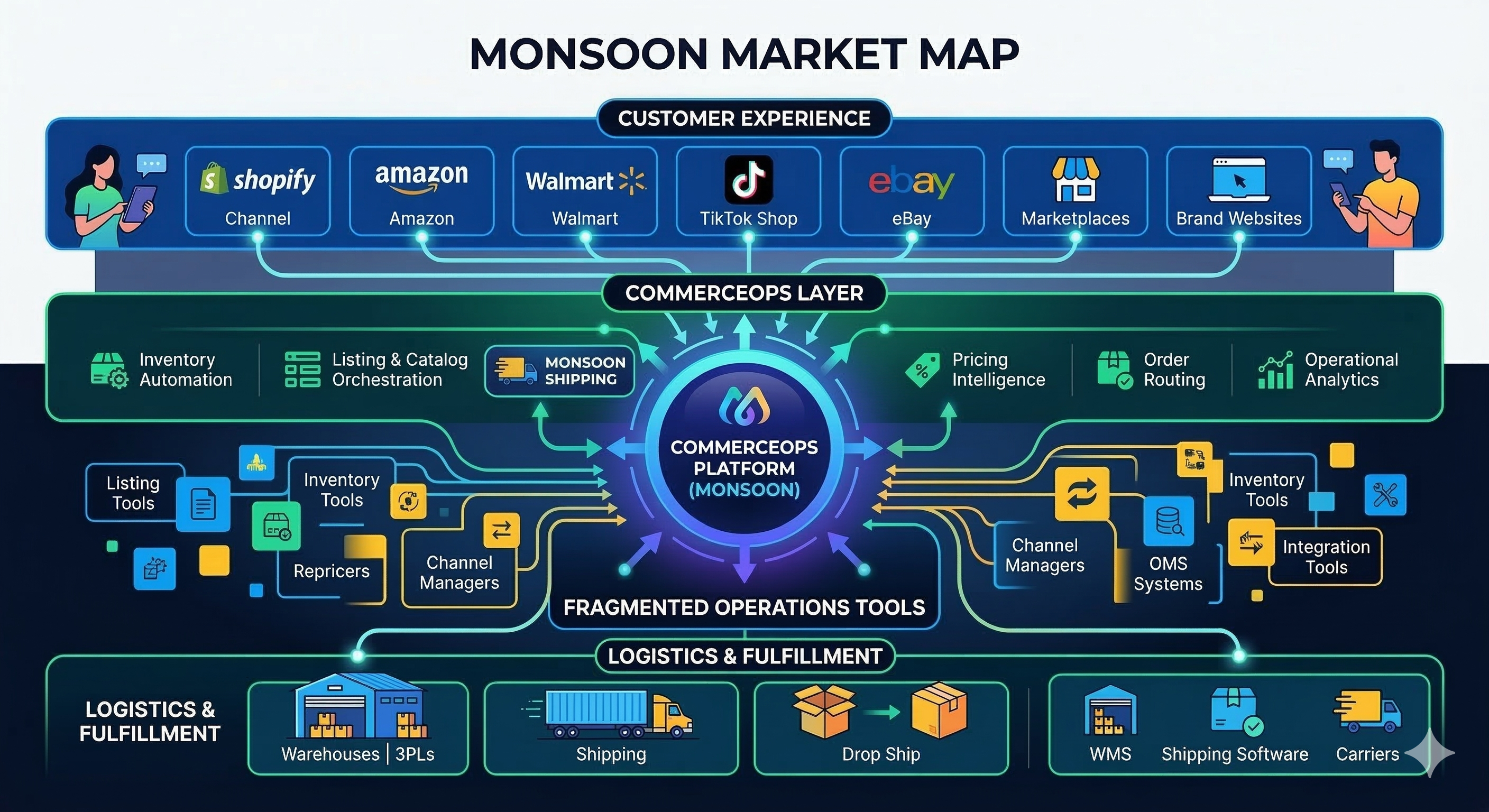
Complexity Scales Faster Than Revenue
Each system operates independently. Each marketplace has its own rules. Each operational workflow requires coordination across systems that were never built to communicate with each other.
The result is an operational environment where complexity scales faster than revenue.
Many commerce teams find themselves hiring more people simply to manage the growing web of systems, integrations, and manual processes required to keep everything synchronized.
Commerce is scaling. Operations are struggling to keep up.
The Commerce Technology Stack Has a Missing Layer
Most commerce technology falls into one of two categories.
The first category focuses on customer-facing commerce platforms. These include platforms like Shopify or marketplaces like Amazon that allow brands to present products and capture demand.
The second category focuses on logistics and fulfillment infrastructure. These include warehouse management systems, shipping software, and 3PL networks that move physical products to customers.
Both layers are critical. But neither is designed to coordinate the operational workflows that sit between them.
Those workflows include:
- Synchronizing inventory across channels
- Managing product listings across marketplaces
- Adjusting pricing in response to market signals
- Routing orders to the correct fulfillment location
- Reconciling operational data across systems
Why Point Tools No Longer Scale
Historically, these tasks have been handled through a collection of point solutions.
Listing tools manage product feeds. Inventory tools track stock levels. Repricing tools adjust marketplace prices. Order management systems route orders.
But each tool solves only a narrow piece of the operational puzzle.
As commerce becomes more complex, businesses end up stitching these tools together with integrations, spreadsheets, and manual processes.
This fragmented approach is what many operators now describe as the duct-tape commerce stack. It is reaching its limits.
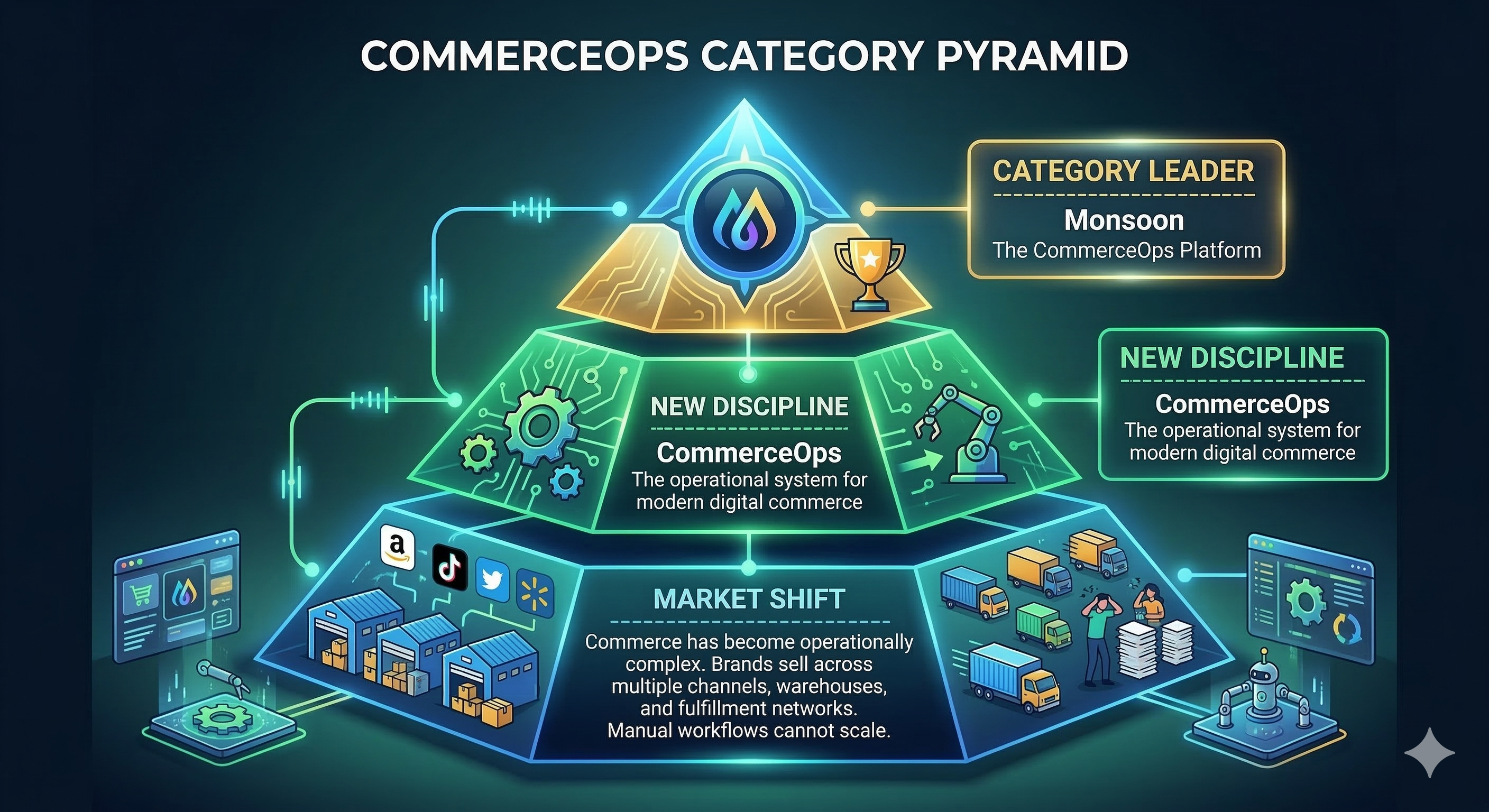
A New Discipline Is Emerging: CommerceOps
What modern commerce businesses increasingly need is not another point tool. They need an operational system.
CommerceOps automates the operational workflows behind modern digital commerce.
It connects channels, inventory, pricing, orders, and fulfillment into a coordinated system that allows businesses to scale operations as efficiently as they scale revenue.
The concept is similar to what happened in software development over the past decade.
Before DevOps, software delivery involved fragmented handoffs between development, testing, and operations teams. DevOps unified these processes into a continuous operational system that allowed software to move from code to production efficiently.
CommerceOps represents a similar evolution for digital commerce.
Instead of managing operational workflows across disconnected tools and manual processes, CommerceOps platforms automate and coordinate these workflows as part of a unified operational infrastructure.
What CommerceOps Enables
When commerce operations are unified and automated, the impact on businesses is significant.
- Products can be launched across multiple channels in minutes rather than weeks.
- Inventory can remain synchronized across warehouses and marketplaces in real time.
- Pricing can automatically respond to competitive signals and demand changes.
- Orders can route intelligently to the best fulfillment location.
- Operational visibility improves dramatically because all activity is coordinated through a single operational system.
Structural Forces Accelerating CommerceOps
Several structural shifts are accelerating the need for this operational layer:
- Channel proliferation: brands now operate across marketplaces, social commerce platforms, and direct-to-consumer channels simultaneously.
- Distributed fulfillment: many businesses now run hybrid models involving multiple warehouses, 3PLs, and distributed logistics networks.
- Real-time market dynamics: pricing, inventory, and order routing decisions increasingly need to respond instantly to demand fluctuations and competitive signals.
The Companies That Win Will Optimize Operations
The first era of ecommerce focused on optimizing the customer experience. Companies competed on storefront design, checkout flows, and shipping speed.
Those innovations remain important, but they are no longer the primary differentiator.
As commerce complexity grows, operational efficiency becomes the new competitive advantage.
The companies that dominate the next era of digital commerce will be the ones that build operational systems capable of coordinating inventory, channels, pricing, orders, and fulfillment seamlessly.
CommerceOps is the discipline that makes that possible.
The Future of Commerce Is Operational
Commerce is becoming more distributed, more dynamic, and more complex every year.
The businesses that succeed in this environment will not simply add more tools or hire more operators.
They will build operational systems that allow commerce to run with the same efficiency and automation that modern software infrastructure achieved through DevOps.
CommerceOps is the operational backbone of that future. And it is only just beginning.